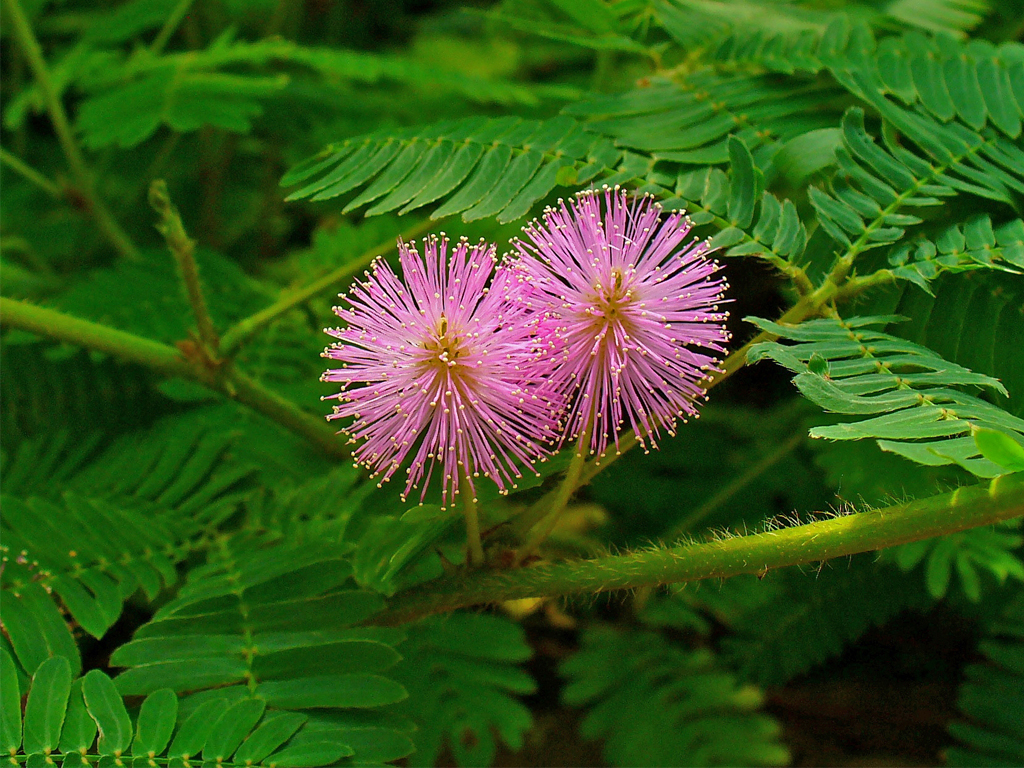
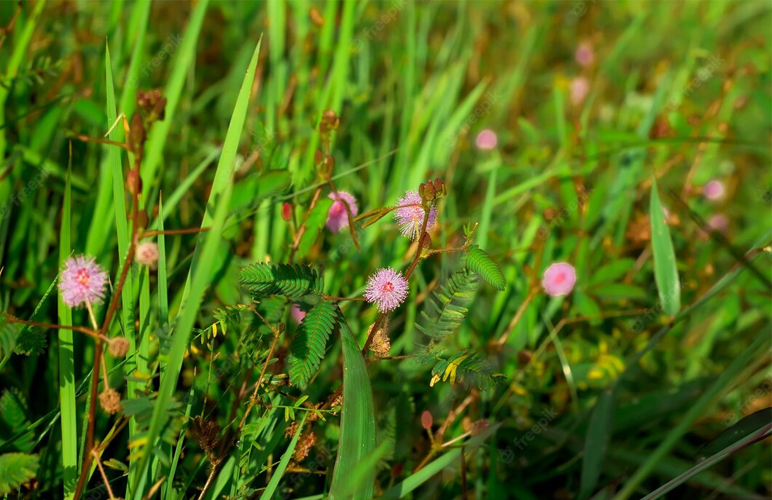
➢ It is a sensitive herb or undershrub. ➢ The stem is cylindrical, branched with recurved prickles. ➢ The leaves are alternate and bipinnately compound. Each leaf has 2- 5 pinnae and each pinnae has 12-20 pairs of leaflets. The leaflets are arranged opposite in pairs, having a linear to oblong shape. The leaves are sensitive in nature and close at night and upon touch, hence the name ‘Touch-me-not’. ➢ The flowers are arranged on globose heads. Each head is on a stalk that is prickled and pink to purple in color. There are four small sepals and four thin petals in each flower, along with four prominent stamens. ➢ The fruits are borne in clusters. Each fruit is an oblong, flattened, recurved pod containing three to five seeds. The pod is pointed at the apex and the margins have bristles on them.
BOTANICAL NAME
Mimosa pudica L
FAMILY
Fabaceae
FLOWERING
Throughout the year
FRUITING
Throughout the year
PROPAGATION
It can be propagated by seeds and vegetative cuttings
✓ The plant is fast growing. It is sometimes grown as an ornamental because the sensitive leaves are fun to interact with. ✓ In folk medicine, the plant is used as anthelmintic, in child birth and in cases of infertility. ✓ The stems and leaves are also used to treat insomnia. ✓ The plant is said to having wound healing and anti-diabetic properties. ✓ The roots are used to treat snake bites. ✓ It is used for bleeding piles. ✓ Leaves are used to treat diarrhea. ✓ It has liver protecting and anthelmintic activity. ✓ Poultice can be made for wounds. ✓ Seeds are used in cases of urinary tract infection (UTIs)