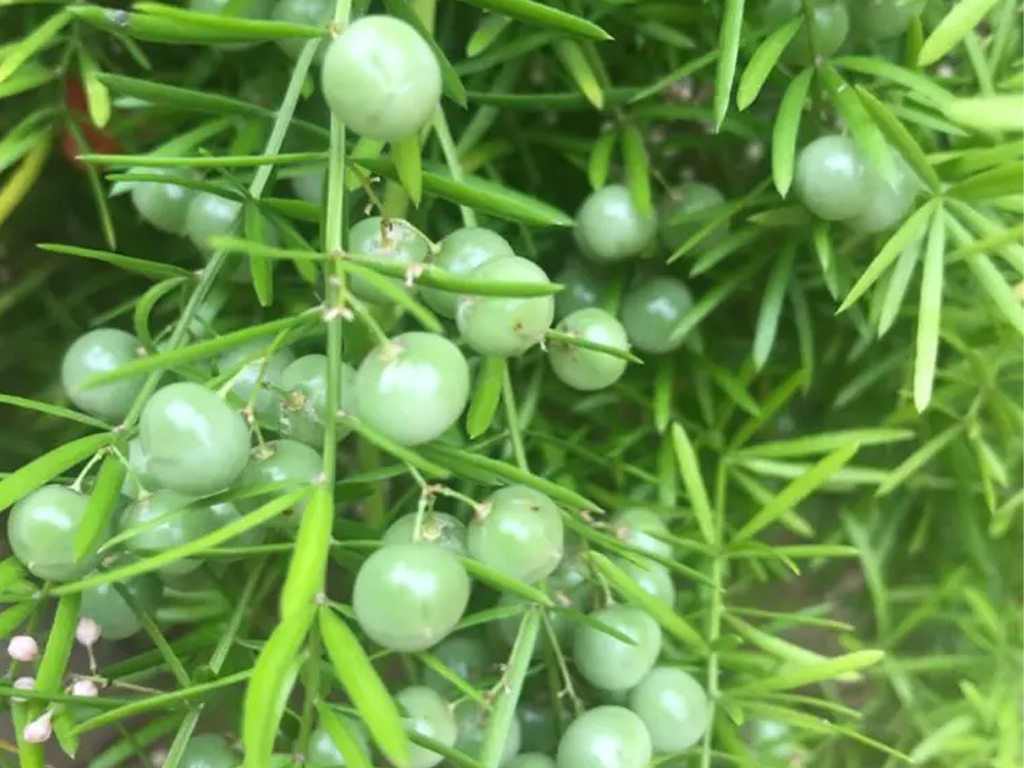
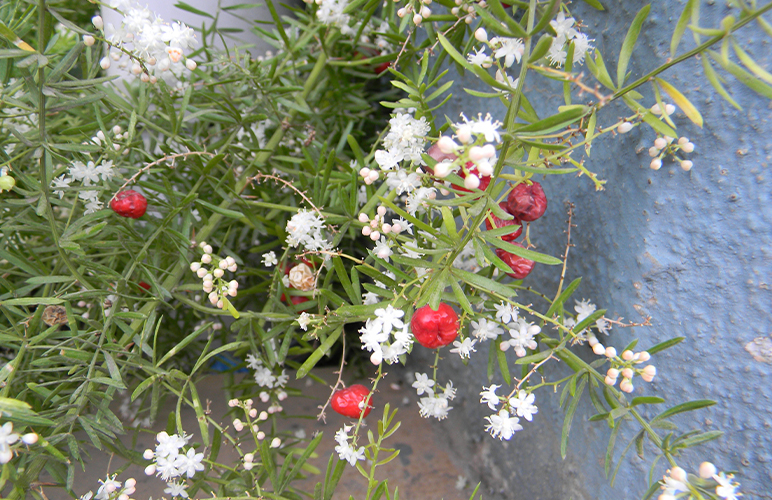
➢ It is perennial climbing herb or sub-shrub. ➢ It is extensively branched, spinous and with fasciculate tuberous roots. ➢ The leaves are minute, scale like, from the axils of which tufts of needle-like or flattened cladodes arise. The cladodes are green, spinous-pointed, slender, slightly curved or straight and two to six at each node. ➢ The flowers are arranged in dense raceme inflorescence. The flowers are small, fragrant, with one or two bracts and six white perianth members. There are six stamens with sub-globose anthers and three stigmas. ➢ The fruit is a round, berry that is green when raw and turns red on maturing.
BOTANICAL NAME
Asparagus racemosus Willd
FAMILY
Asparagaceae
FLOWERING
October – November
FRUITING
October – January
PROPAGATION
It can be propagated by seeds or by vegetative cuttings
✓ The plant is an ornamental. ✓ The roots are used in Ayurveda to treat piles, diarrhea, dysentery, arthritis, cough, bronchial infections and fever. ✓ Women used it to treat conditions related to hormone imbalance. ✓ It helps reduce the free-radical skin damage that leads to wrinkles. It has anti-aging properties. ✓ It helps to boost your immune system. ✓ It has antioxidant properties. ✓ It may help treat kidney stones. ✓ They are also used as an aphrodisiac and a rejuvenate, tonic. ✓ The plant is also used to treat depression.